 By the Vietnam Expat team. Last reviewed 2026-09-23
What goes into a Vietnam investment risk checklist?
A Vietnam investment risk checklist puts each assumption behind a deal on its own line. Those lines cover who can legally hold the asset, what tax and currency rules attach to it, and what the exit is likely to cost.
Then you change one line at a time and note which outcomes hang on a number nobody has confirmed yet.
Five lines carry most of the weight:
- Title and ownership: the buyer type, the ownership cap and the term, from the Housing Law and Decree 95/2024/ND-CP.
- Purchase tax and fees: the VAT, registration fee and maintenance fund, from the Government Portal and Savills.
- Rental income: a realistic yield and the management fee.
- Currency: the exchange rate from the State Bank, plus a transfer channel confirmed with your bank, not assumed from Circular 03/2025/TT-NHNN.
- Exit and resale: the transfer tax and the spread between published prices.
Sources: LuatVietnam (1, 2, 6), Vietnam Government Portal (8, 12), Savills Vietnam, Ho Chi Minh City Party Committee portal, CafeBiz, Tilleke and Gibbins, State Bank of Vietnam, Dezan Shira and Associates, CBRE Q2 2026 Ho Chi Minh City market report
Can a foreigner own the property, or only lease it?
As a foreign individual, you can own the building itself, meaning the apartment or house, but not the land under it. Vietnam's land belongs to the people as a whole, with the State acting as owner's representative. So a foreign buyer holds a time-limited ownership certificate rather than a land title.
Foreign-invested companies face different rules than individuals do. Vietnam's Land Law lists these companies, unlike foreign individuals, as recognized land users. But Article 28 limits them to acquiring land use rights, the legal right to use a plot, inside industrial parks, cottage-industry zones and hi-tech parks.
On land leased with annual rental payment, the law limits those rights. A firm can only mortgage the assets attached to the land, add them as capital, sell them together with its right to lease the land, or sublease.
The Housing Law caps how much of a building foreigners can hold. Individuals and eligible foreign organizations together may own no more than 30 percent of the apartments in one condominium building or block, combined across all foreign buyers.
The same cap applies to landed houses: no more than 250 in one ward-sized area, combined across every project there. The ownership term itself runs up to 50 years from the certificate date, under Housing Law Article 20.
An extension needs at least 3 months notice before the term ends. The provincial People's Committee then has 30 days to answer, and a yes adds up to 50 more years.
When we checked in September 2026, we found no published national count of buildings that have filled that cap. Whether one specific building has already filled its 30 percent quota is a question for that building's management board or the developer. We'd ask that question before paying any deposit.
Sources: LuatVietnam (1, 2, 3)
What happens if a nominee or a company structure gets challenged?
Vietnamese courts treat the person named on the paperwork, the nominee, as the real owner, no matter what private side agreement exists with the actual investor. There's no legal framework for a nominee arrangement, so a dispute in court is likely to find the arrangement itself invalid.
That covers a spouse, a friend or a local company used to get around the 30 percent cap. If that structure is tested in court, the name on the paperwork is the only owner the court will recognize.
Our property risk and protections page goes further into how these ownership and title questions can move.
Sources: Conventus Law, LuatVietnam
Which published price should your purchase line use?
None of them alone. At least three separately published Q2 2026 averages for Ho Chi Minh City apartments ranged from about 62 million to 108 million dong per square meter, a spread of roughly 74 percent. So your checklist should hold a range, not one number.
| Publisher | Million dong per m2 | Basis |
|---|---|---|
| Ministry of Construction | 108 | Citywide |
| CBRE | 76 new, 62 resale | Net area |
| JLL | 98.1 | New launch |
Source: Vietnam Government Portal, CBRE and JLL market reports, as of 2026-09-23.
A boundary can move the number without moving a single price. CBRE's own chief executive said the Ho Chi Minh City average fell from about 92 million to about 76.1 million dong per square meter. The drop came once the 2025 provincial merger changed which districts count as the city.
The Ministry of Finance also found that recorded contract prices ran 20 to 40 percent below real transaction prices from 2021 to 2023. A price written into a contract isn't always the price that changed hands.
For the wider growth and inflation numbers behind any Vietnam price trend, see our Vietnam economy page.
Sources: Vietnam Government Portal, CBRE Q2 2026 Ho Chi Minh City market report, JLL Q2 2026 report, Sai Gon Giai Phong, Ministry of Finance data
What do you pay on top of the price?
Four charges sit on top of the headline price: value-added tax, a registration fee, a one-time maintenance fund payment, and a personal income tax if you ever sell.
Take a 70 square meter unit at the Ho Chi Minh City average, 7.56 billion dong, about 292,683 US dollars at Vietcombank's rate. Real estate keeps the 10 percent standard VAT rate, with no cut under Resolution 204/2025/QH15.
That rate doesn't apply to the full 7.56 billion dong. Vietnam's VAT law taxes the selling price minus the land value paid to the state, so the real bill runs below a flat 756 million dong. Ask the developer for the VAT-inclusive quote, or confirm the figure with an accountant.
The registration fee at 0.5 percent adds 37.8 million dong, 1,463 US dollars. The one-time maintenance fund at 2 percent adds another 151.2 million dong, 5,854 US dollars.
A later sale would owe 2 percent of the transfer price in personal income tax, the same 151.2 million dong on this example.
Sources: LuatVietnam (1, 6, 24), Vietnam Government Portal (8, 12), Savills Vietnam, Vietcombank, Dezan Shira and Associates
What does the rental income assumption need to net out?
One Q2 2026 market report put yields at 2.32 percent in Hanoi, 3.30 percent in Ho Chi Minh City, and 4.34 percent in Da Nang.
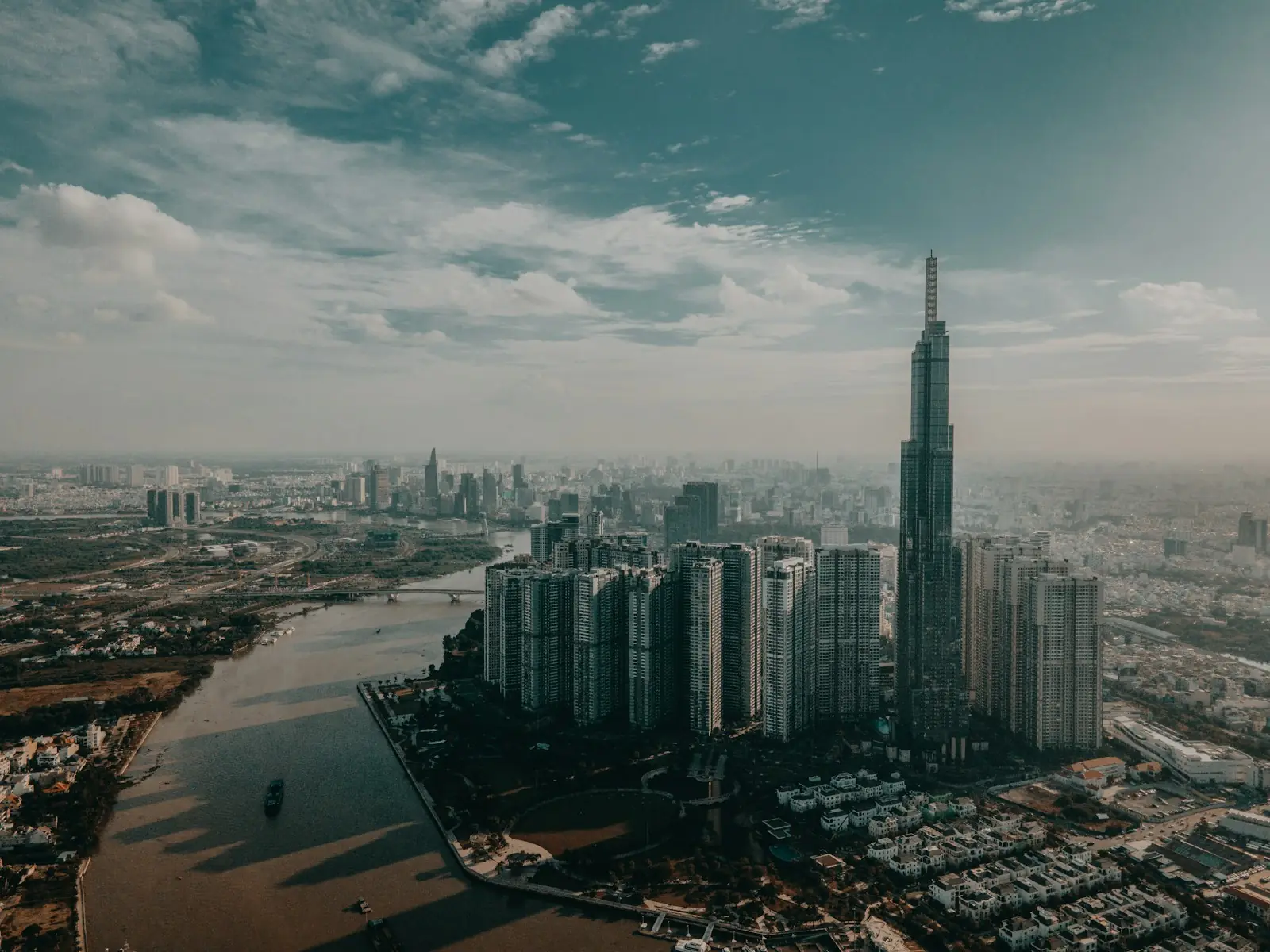
See a full breakdown of rental yield by city for the rest of that math.
The management fee itself runs 600 to 3,500 dong per square meter a month without a lift in Ho Chi Minh City. With a lift, the city's band runs 1,800 to 7,000 dong per square meter a month.
Sources: CafeBiz, Ho Chi Minh City Party Committee portal
What changes when the deal is priced in US dollars?
The exchange rate moves daily and sits outside any of the caps above. Vietcombank's transfer rate was 25,830 dong per US dollar on 2026-09-23. The State Bank's own central rate two days earlier was 25,637, so the rate you get depends on the bank and the day.
Getting profit back out is a separate question from the exchange rate. Circular 03/2025/TT-NHNN covers accounts for non-resident investors who trade securities and shares, not a home sale.
It also gave some exempt firms until 16 June 2026, now past, to open a Direct Investment Capital Account instead, a route for foreign-invested firms. Confirm the real transfer channel for your own money with your bank before you sign anything.
Sources: Vietcombank, State Bank of Vietnam, Tilleke and Gibbins
What does the exit or resale scenario cost?
Selling costs money even before any capital gain is counted. A seller owes personal income tax of 2 percent of the transfer price, a flat rate that applies whether the unit gained value or lost it.
Given the recorded-price gap in the purchase price section above, check which price the contract records before putting it in the exit line.
For the rest of the exit math, currency conversion included, see the full resale and exit cost breakdown.
Sources: Savills Vietnam, Dezan Shira and Associates, Ministry of Finance data
What protects your deposit if a project stalls before it's finished?
Less than it used to. The 2023 Law on Real Estate Business took effect in August 2024, and a developer can collect no more than 5 percent of the price as a deposit on an unfinished unit.
The buyer can now sign away the bank guarantee that used to be mandatory in every case. That waiver has to be in writing at contract signing, so check the contract for the guarantee by name.
The same paperwork habit matters for a plain deposit on a finished rental. Police in Bac Ninh charged two people over a rental deposit sent to a suspect's brother's account. A separate case in An Giang involved a 135 million dong shophouse deposit paid to someone with no authority from the owner.
Check the beneficiary name on every transfer against the actual seller, developer or landlord on the contract.
Sources: Ngo and Partners, Ministry of Public Security (19, 20)
How fast do the rules change?
Fast enough to matter inside one deal's timeline. On 2024-08-01 the Housing Law, the Land Law and the Real Estate Business Law all took effect, after Law 43/2024/QH15 brought them forward from an original 2025-01-01 start. Decree 95/2024/ND-CP sets the caps described above.
On 2025-07-01 the VAT cut to 8 percent began; real estate stayed at 10 percent.
Circular 03/2025/TT-NHNN, issued 2025-04-29, reset accounts for non-resident investors.
On 2026-07-01 a new personal income tax law took effect, so an income tax line needs the current law, not an older summary.
Check the effective date on every rule here, including our own summary, before you use it in a live decision.
Sources: LuatVietnam (1, 2, 3), Ngo and Partners, Dezan Shira and Associates, Vietnam Government Portal, Tilleke and Gibbins, Ministry of Finance
How do you stress-test one assumption at a time?
Change one input and hold the rest still. Move the purchase price from the low end of the published range to the high end, about 62 to 108 million dong per square meter. Watch how many years of rental income it takes to close that gap before touching any other number.
Do the same for the exchange rate, the rental yield and the exit tax, one at a time, and write down which conclusion depends on the weakest, least recent number. Verify that line first.
Sources: CBRE Q2 2026 Ho Chi Minh City market report, Vietnam Government Portal, Vietcombank, CafeBiz, Savills Vietnam
Does this checklist change for a US citizen or green card holder?
The Vietnam side doesn't change, but a second layer gets added. The Internal Revenue Service says citizens and resident aliens are subject to tax on worldwide income from all sources, wherever they live. A foreign account can also trigger a separate reporting duty, regardless of whether it ever earned interest.
That reporting duty is separate from whether you owe any tax, which is a question to confirm with a US tax preparer. It exists because the account is foreign, so a US buyer's worksheet needs a line for it even when every other number looks clean.
The numbers here don't replace a lawyer, a tax adviser or a bank's own written answer for your specific paperwork. Use our investing research hub for Vietnam and the sources below as a starting point, then get a professional to check the exact document in front of you.
Source: US Internal Revenue Service